How smart property investors can create multiple income streams, serve a growing market of temporary residents, and build long-term real estate wealth.
Real estate investing is evolving. While traditional long-term rentals and vacation properties remain popular, another investment strategy deserves serious consideration: the hybrid rental property.
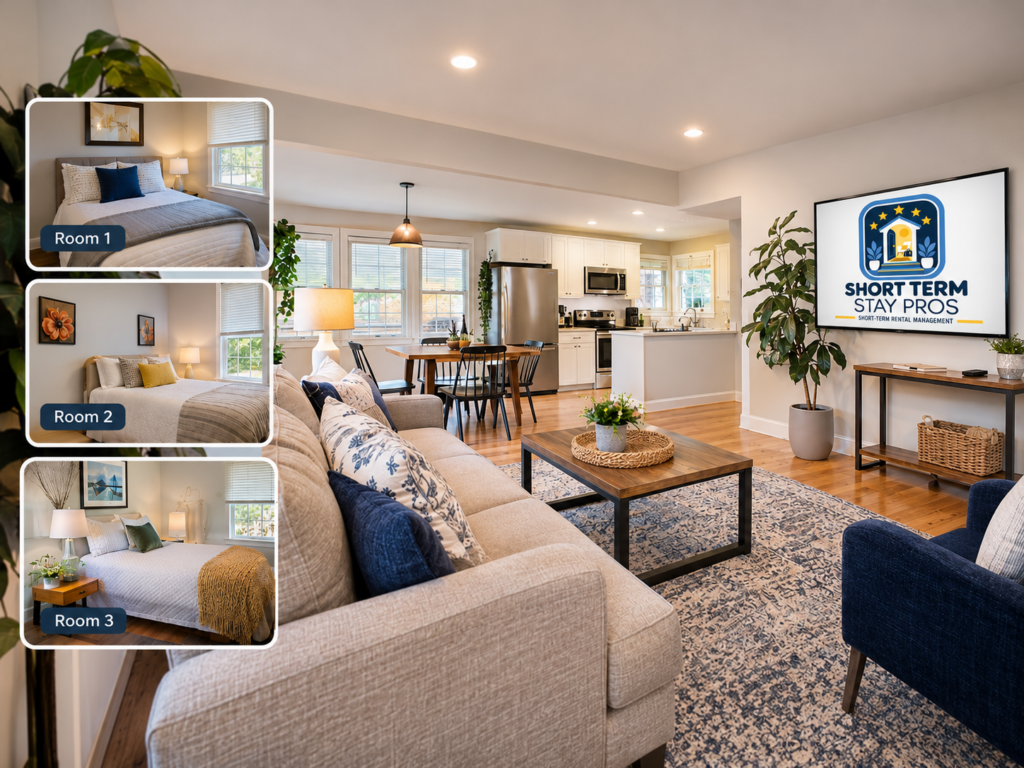
This approach combines short-term stays with furnished mid-term rentals, allowing property owners to rent individual bedrooms rather than the entire home to one tenant or group.
For investors who purchase the right property, in the right market, with the right management strategy, this model can create attractive income opportunities and greater flexibility.
At Short Term Stay Pros, we work with property owners who recognize the potential of furnished, flexible housing. Whether you’re purchasing strictly for investment purposes or want to own a property in an area where you have personal connections, understanding this business model can open up opportunities worth exploring.
What Is a Hybrid Short-Term and Mid-Term Rental Property?
A hybrid rental property combines different lengths of stay within one professionally managed property.
Rather than renting an entire house under a traditional annual lease, an owner may offer individual furnished bedrooms with access to shared common areas, including kitchens, living rooms, bathrooms, and laundry facilities.
Depending on local regulations and property configuration, guests may include:
Short-term guests: Individuals booking accommodations for a few nights or weeks.
Mid-term residents: Traveling professionals, students, relocating individuals, and others seeking furnished accommodations for approximately 30 days or longer.
Extended-stay residents: Individuals who prefer furnished housing with flexible lease terms rather than committing to a traditional year-long rental.
The appeal is flexibility. A bedroom might be occupied by a traveling healthcare professional for three months, while another could accommodate a visiting family member for a shorter stay, provided the property’s permitted use allows both arrangements.
This creates the potential to reach several rental markets instead of depending on a single type of tenant.
Why Demand for Furnished, Flexible Housing Is Growing
Today’s workforce is increasingly mobile. Healthcare professionals, contract employees, educators, researchers, and other professionals frequently need comfortable accommodations away from their permanent homes.
Hospitals, medical facilities, universities, colleges, and major employers can help create demand for temporary and mid-term housing.
In fact, research published in 2026 by Furnished Finder and AirDNA reported that U.S. demand for stays of 28 days or longer increased 138% between 2019 and 2025.
However, national growth does not guarantee local demand. Investors still need to research their specific market.
Who rents furnished rooms?
Healthcare professionals: Traveling nurses, physicians, technicians, and other medical professionals may need accommodations for temporary assignments lasting several weeks or months.
Higher education professionals and students: Graduate students, visiting professors, researchers, interns, and students participating in specialized programs may prefer furnished rooms rather than traditional apartments.
Contract and project workers: Construction supervisors, engineers, utility workers, consultants, and other professionals assigned to temporary projects often need accommodations with predictable costs.
Relocating individuals: People moving for work, navigating a life transition, or searching for permanent housing may benefit from furnished, flexible accommodations.
Visiting family members: Individuals traveling to visit relatives, attend special occasions, or support family members may appreciate access to a private bedroom and shared household amenities.
The key is identifying communities with multiple sources of demand rather than relying on one employer, university, or seasonal attraction.
What Should Investors Look for When Purchasing a Hybrid Rental Property?
Not every home is suitable for a room-by-room rental business.
The most successful investments begin with careful property selection and realistic financial planning.
1. Multiple bedrooms and adequate bathrooms
Properties with four, five, or six bedrooms may offer attractive rental income potential because each bedroom represents a separate revenue opportunity.
However, the number of legally rentable rooms matters more than the number advertised in a listing.
Ideally, investors should look for:
At least four appropriately sized, legally recognized bedrooms.
Multiple full bathrooms to minimize congestion.
Comfortable shared living and dining areas.
A functional kitchen with sufficient storage and refrigerator space.
Convenient laundry facilities.
Adequate parking for multiple occupants.
Proper heating, cooling, ventilation, and internet connectivity.
Private bathrooms can command premium rents in certain markets, but they may also increase acquisition or renovation costs.
Investor tip: A five-bedroom house with three bathrooms may be a stronger room-rental candidate than a six-bedroom house with only one bathroom.
2. A layout designed for shared living
Privacy and functionality are especially important when unrelated individuals occupy the same property.
Look for bedrooms that provide reasonable separation, shared spaces that can accommodate multiple residents, and conveniently accessible bathrooms.
Smart locks, good lighting, durable furnishings, sound management, and clearly defined common areas can contribute to a better resident experience.
Storage space matters, too. Each occupant should have adequate room for food, personal belongings, and everyday necessities.
3. Proximity to employment and educational centers
Location remains one of the most important factors in real estate investing.
For hybrid rentals, investors should evaluate proximity to:
Hospitals and medical centers.
Universities and colleges.
Major employment centers.
Industrial facilities and project-based workplaces.
Public transportation and commuter routes.
Grocery stores, pharmacies, restaurants, and other everyday conveniences.
A property that appeals to several groups of temporary residents may offer better year-round occupancy potential than one dependent entirely on tourism.
4. A property that can adapt to changing demand
Flexibility should be part of the investment strategy.
Ideally, the property could serve as a furnished room rental today and transition to another permitted use in the future.
Possible alternatives include traditional annual leasing, whole-home furnished rentals, or renting separate legal units independently.
This flexibility can be valuable if regulations, local employment patterns, or rental demand change.
Before purchasing, investors should verify zoning, occupancy classifications, fire and building codes, parking requirements, licensing, insurance, and any restrictions on mixing short-term and longer-term occupants.
Important: A property that can legally be rented to one household is not automatically approved for separate room rentals. Combining transient guests and longer-term residents may trigger additional requirements or be prohibited entirely.
Understanding the Income Potential
One of the biggest advantages of renting by the room is the potential to generate more gross rental income than leasing an entire property to one household.
Consider a hypothetical five-bedroom property.
| Rental Strategy | Potential Gross Monthly Income |
|---|---|
| Traditional whole-home rental | $2,800 |
| Five furnished rooms at $1,050 each | $5,250 |
| Five furnished rooms at $1,200 each | $6,000 |
These figures are hypothetical examples for comparison, not market-based rental estimates or guaranteed earnings. Actual rates, occupancy, and legal uses must be verified.
The room-rental model may generate significantly more gross revenue, but it also comes with additional responsibilities and expenses.
Owners must account for utilities, internet, furniture, cleaning, consumable supplies, insurance, property taxes, maintenance, platform fees, vacancies, management, and periodic replacement of furnishings.
Financing and initial setup expenses also affect investment returns.
A sound financial analysis should include conservative occupancy projections, realistic expenses, replacement reserves, and a backup rental strategy.
The goal isn’t simply to maximize rent. It’s to maximize sustainable net income while protecting the property’s long-term value.
Why Investors May Want to Purchase a Property Away From Home
Not every real estate investment needs to be located near an investor’s primary residence.
Some owners purchase properties in communities where they have personal connections. Perhaps their children are attending college nearby, they have family in the area, they visit regularly, or they envision retiring there one day.
We’ve worked with property owners whose personal ties to the area helped inspire their investment decisions.
For these buyers, a rental property can serve more than one purpose: generating income today while establishing a long-term connection to a community that matters to them.
Other investors have no personal connection to the area at all. They’re simply searching for communities where acquisition costs, rental demand, and income potential make financial sense.
Both approaches can be valid.
What matters is identifying a suitable property and having reliable local management in place.
Why Professional Property Management Is Especially Important
A hybrid rental property is not a passive investment simply because its bedrooms are furnished.
Managing multiple residents with different arrival dates, departure dates, rental agreements, and expectations requires organization, responsiveness, and consistent oversight.
Unlike a traditional rental with one household, room-by-room rentals often require individual bookings, resident screening, coordinated cleaning, inventory management, and attention to the relationships between occupants.
For investors who don’t live nearby, professional management is particularly valuable.
How Short Term Stay Pros Helps Property Investors
Short Term Stay Pros provides hands-on management services for furnished short-term and mid-term rental properties, helping owners manage the operational demands of their investments.
Our services can include:
Property evaluation and rental strategy
We help prospective and existing owners evaluate how a property’s layout, amenities, and target rental market may influence its income potential.
Listing creation and marketing
We develop compelling property listings, coordinate professional photography and staging, and market accommodations through appropriate rental platforms and channels.
Dynamic pricing and occupancy management
Rental demand changes throughout the year. We monitor pricing opportunities and availability to help position properties competitively.
Resident screening and booking coordination
We assist with inquiries, applications, background screening where appropriate, rental arrangements, and guest communications.
Property setup and technology
From furnishings and supplies to smart locks, security measures, and guest-access systems, we help prepare properties for efficient operation.
Cleaning and property maintenance coordination
We coordinate reliable cleaning services, turnover preparations, routine housekeeping, supplies, and maintenance concerns to help properties remain attractive and functional.
Resident communications and house rules
Shared housing operates best with clear expectations. We establish and communicate property rules addressing cleanliness, quiet hours, shared spaces, visitors, and other important household considerations.
Local oversight for remote investors
For property owners living outside the area, having an established local management team offers a practical way to own an investment property without personally handling every booking, cleaning issue, maintenance request, or resident concern.
Our goal is to help property owners provide quality accommodations while operating their rental properties as organized, professionally managed businesses.
Five Questions to Ask Before Buying
Before making an offer on a potential hybrid rental property, investors should answer these five questions.
Is the intended rental model legally permitted? Confirm that local rules allow the proposed number of occupants, independent room rentals, and the mix of rental durations.
Is there sufficient demand? Research healthcare facilities, educational institutions, major employers, competing furnished rentals, and realistic occupancy patterns.
Will the property produce satisfactory net income? Calculate returns using conservative assumptions rather than maximum possible revenue.
What improvements are necessary? Include furniture, safety upgrades, smart locks, kitchen supplies, linens, and other initial expenses in the acquisition budget.
Who will manage the property? Determine whether you have the time, local resources, experience, and systems required to operate a multi-resident property effectively.
A Smarter Way to Approach Rental Property Investment
Hybrid rental properties offer an interesting alternative to conventional real estate investing.
The ability to serve different types of temporary residents, generate income from individual bedrooms, and adjust rental strategies as demand changes can make the model appealing.
But success depends on choosing the right property, understanding the local market, complying with applicable regulations, and maintaining a professional operating environment.
A property that looks attractive on paper may not perform well if its layout is unsuitable, expenses are underestimated, or management is inconsistent.
That’s why rental strategy should be part of the conversation before purchasing a property, not after closing.
Considering a Hybrid Rental Property Investment? Talk to Short Term Stay Pros.
Whether you’re exploring your first investment property, expanding an existing portfolio, or buying a home in an area where you have family or personal connections, Short Term Stay Pros can help you evaluate the operational side of owning a furnished rental.
We understand the challenges of managing shared accommodations, serving temporary residents, maintaining quality standards, and coordinating properties for owners who may live miles away.
Before you buy, let’s discuss your investment goals, the type of property you’re considering, and whether a professionally managed short-term and mid-term rental strategy makes sense.
Contact Short Term Stay Pros to explore your rental property investment opportunities.